For parents figuring it out
Raise kids who can think clearly in an AI world
Practical frameworks to help your children use AI without becoming dependent on it.
I'm not here to encourage AI use with kids.
I'm here because your kids will encounter AI whether you want them to or not. I'd rather they learn the right habits from you than the wrong ones on their own.
AI is here. Schools aren't ready. What do we do?
Your kids now have a tool that can answer any question instantly, write essays in seconds and "help" with homework by doing all the thinking for them.
The upside is obvious. Used well, AI could supercharge creativity and curiosity.
But there's a real danger too, kids outsourcing their thinking, losing problem-solving skills and growing up dependent on a chatbot to do the hard mental work for them.
The schools are still figuring it out. You shouldn't wait.
"The mind is not a vessel to be filled, but a fire to be kindled."
- Plutarch The 80% Rule
Start on their own
Your child does 80% of the work themselves first. Let them wrestle with the problem, get stuck and think it through.
Bring in AI for guidance, not shortcuts
Only after they have tried, they use AI for feedback, not answers. "What's weak here? What am I missing?"
Help them grow from it
They revise based that feedback. The effort is theirs, the ideas are theirs and the learning actually happens.
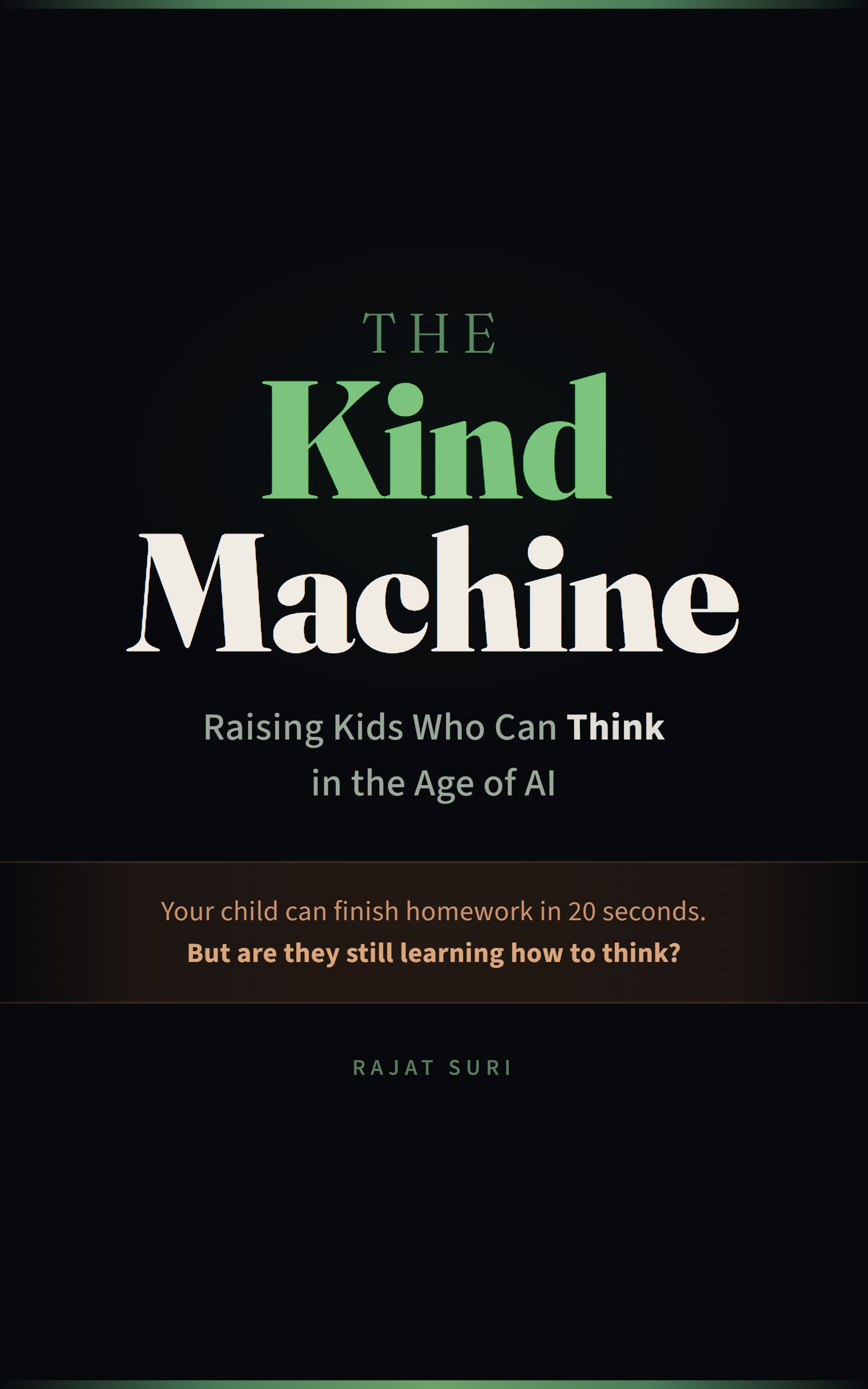
The Kind Machine
Everything on this site started here. The 80% Rule, the conversation scripts, the age-by-age playbook, plus what you won't find online: AI companions, deepfake protection, and the full set of activities organized by thinking skill.
Short enough to finish in one evening. Practical enough to use tonight.
Get the BookAI is a Kind Machine
AI is always patient. It's never tired, never annoyed and always encouraging. That can feel comforting, especially to kids.
But real growth doesn't come from comfort alone. It comes from friction, making mistakes, feeling the sting of being wrong and hearing honest feedback that isn't always easy to take.
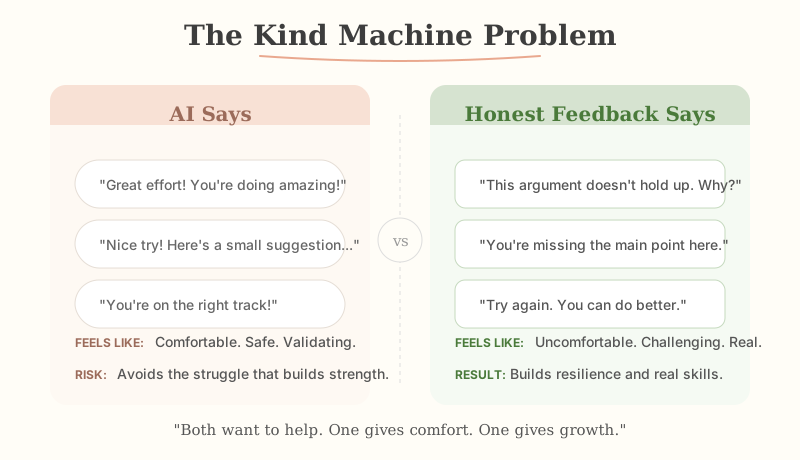
AI Says
Feels like: Comfortable. Safe. Validating.
Risk: Avoids the struggle that builds strength.
Honest Feedback Says
Feels like: Uncomfortable. Challenging. Real.
Result: Builds resilience and real skills.
"Both want to help. One gives comfort. One gives growth."
Start based on your child's age
AI Activities That Build Thinking
Curiosity Deep Dives
Turn any topic into an exploration by asking AI the questions nobody else thinks to ask.
Try Curiosity Deep Dives →What Would You Build?
Teach kids to think like builders, not consumers. Imagining what they could create with AI as a tool.
Try What Would You Build →The Human Connection
Compare AI advice to human connection. Discovering why empathy matters more than perfect words.
Try Human Connection →AI voice cloning can now copy anyone in 30 seconds
Your child could receive a call that sounds exactly like you or vice versa. Every family needs a verification protocol. We've created a simple one.
Get the Family Safety Protocol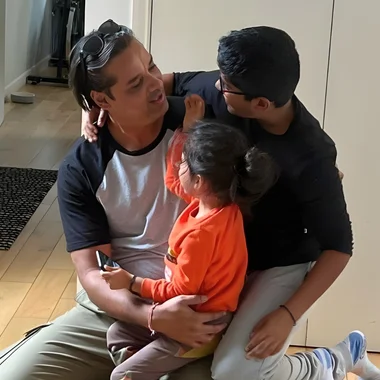
Father of two. Figuring this out alongside you.
I have two boys, one is 13, deep in the AI homework era and one is 6, still building his foundation. Every framework I share here, I'm testing at home first.
I put everything I've learned into a book called The Kind Machine, the guide I wished existed when my kids started asking about AI.
Frequently Asked Questions
What is the 80% Rule for AI?
The 80% Rule is a framework where kids complete 80% of their work themselves before AI enters. When AI does enter, it critiques the work, it doesn't complete it. The child then improves it themselves. This keeps the thinking theirs. Learn the full framework.
Should I let my child use ChatGPT for homework?
Yes, but with structure. Using the 80% Rule, your child completes their work first, then uses AI for feedback and critique, not answers. This way they learn while still benefiting from AI assistance.
At what age should kids start using AI?
Ages 6-9 should have minimal AI exposure with full supervision. Ages 10-12 can begin using the 80% Rule with parental guidance. Teens 13+ can practice independently while parents audit occasionally. See detailed age guidance.
Join 1,000+ parents raising kids for an AI world
Weekly frameworks, stories and tools with practical insights you can use everyday.
No spam. Unsubscribe anytime.