The Problem We're Solving
Your child opens ChatGPT. Types "write an essay about the French Revolution." Gets 500 words in 10 seconds. Copies. Pastes. Done.
What did they learn? Nothing. What skill did they build? None. What happens when they face a problem AI can't solve? They freeze.
This isn't hypothetical. Teachers are watching it happen in real-time. Kids who used to struggle productively now struggle to start without AI. The cognitive muscle is atrophying before it's even built.
But banning AI isn't the answer either. These tools are powerful. Your kids will use them their entire lives. The question isn't whether they use AI-it's how.
The 80% Rule: A Framework
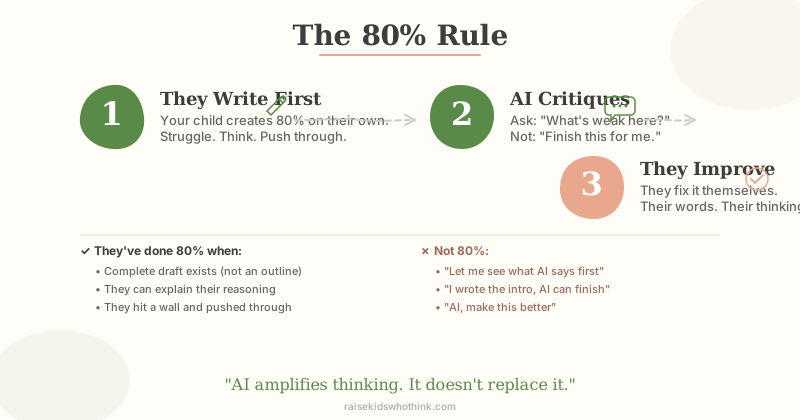
The 80% Rule is simple: Your child must create 80% of any work themselves before AI enters the picture.
But here's the key-AI's role isn't to finish the remaining 20%. AI's role is to critique what they've created, so they can make it better themselves.
The Core Principle
AI amplifies thinking. It doesn't replace it. The struggle is where the growth happens.
What Counts as 80%?
The canonical definition: Complete 80% of your work - a full first attempt with your own reasoning - before asking AI to critique it.
Your child has done 80% when all three are true:
- They have a complete first draft or solution. Not an outline. Not bullet points. A finished version they could submit if AI didn't exist.
- They can explain their reasoning without notes. If asked "why did you write it this way?" they have an answer that isn't "I don't know."
- They've hit at least one wall and pushed through. They encountered something hard and made a decision, even if it turns out to be wrong.
What doesn't count as 80%:
- "Let me just see what AI says first." Exposure to AI output before attempting contaminates their thinking. They must attempt first.
- "I wrote the introduction, can AI do the rest?" An intro is not 80%. A complete draft is 80%.
- "AI, make this better." This outsources the improvement. Ask "what's weak here?" instead, then they fix it themselves.
How It Works (Step by Step)
Step 1: They Write First (80%)
Your child tackles the assignment on their own. They struggle. They think. They get stuck and push through. They produce something imperfect but theirs.
This is where learning happens. The neural pathways form when we struggle, not when we consume answers.
What this looks like:
- A rough draft essay with gaps and weak arguments
- A math problem worked through with some wrong turns
- A creative story that's messy but imaginative
- Code that mostly works but has bugs
Step 2: AI Critiques (Not Completes)
Now-and only now-they can bring in AI. But not to ask "finish this for me." Instead:
Prompts that work:
- "What's the weakest argument in my essay?"
- "Where does my logic break down?"
- "What am I missing that would make this stronger?"
- "Point out three things I could improve, but don't fix them for me."
- "If you were grading this, what would you mark wrong?"
Prompts to avoid:
- "Rewrite this for me"
- "Make this better"
- "Finish this paragraph"
- "What's the answer?"
Step 3: They Improve (Themselves)
Armed with feedback, your child revises. They address the weak points AI identified-but in their own words, with their own thinking.
The work stays theirs. The improvement is real. The learning compounds.
Why This Works (The Science)
Learning researchers call it "desirable difficulty." When things are too easy, we don't retain them. When we struggle and then succeed, the learning sticks.
AI that does the work removes the difficulty. AI that critiques the work preserves it-while adding the benefit of personalized feedback.
Think of it like weightlifting. Having someone else lift the weights doesn't make you stronger. But having a coach watch your form and suggest corrections? That accelerates real growth.
The Kind Machine Problem
AI is always patient, never moody, and endlessly positive. It gives comfort when a child might need honest correction. Children may turn to AI not just for answers, but for affirmations.
The 80% Rule protects against this: by the time AI enters the picture, the struggle has already happened. AI becomes a coach, not a crutch. That's why "complete first attempt" matters - it ensures they've felt the friction before AI smooths it away.
Read more: The Kind Machine vs The Honest Teacher →Red Flags: When to Reset
Watch for these signs that the balance has tipped wrong:
Warning Signs
- Can't start without AI: "I just need to see what it says first"
- Answers get shorter: Their initial drafts shrink over time
- Copy-pasting feedback: They're using AI's suggestions verbatim
- Resistance to struggle: Any friction triggers "let me ask ChatGPT"
- Opinion outsourcing: They can't form views without checking AI first
If you see these patterns, reset. Go back to AI-free work for a while. The muscle needs to rebuild.
Age-Specific Adjustments
Ages 6-9: The 100% Rule
Honestly? At this age, the rule might be 100%-no AI for their work at all. They're building foundational skills: handwriting, basic reasoning, imagination. AI can wait. If you use AI at all, use it together, for exploration and curiosity-never for their assignments.
Ages 10-12: The 80% Rule (Training Wheels)
This is when to introduce the framework. Sit with them the first few times. Model the right prompts. Help them resist the temptation to ask AI for answers. They're learning a skill as important as any subject: how to use a powerful tool responsibly.
Ages 13+: The 80% Rule (Independent)
By now, they should be running the framework themselves. Your role shifts from supervisor to occasional auditor. Spot-check their work. Have conversations about how they're using AI. Trust, but verify.
Making It Stick: Implementation Tips
- Make it explicit. Don't assume they'll figure out the right approach. Explain the rule, the reasoning, and the consequences of violating it.
- Use the language. "Did you do your 80% first?" becomes a household phrase.
- Check the prompts. Ask to see what they asked AI. The prompts reveal everything.
- Celebrate the struggle. When they're stuck, that's not a problem-that's the goal. Normalize productive frustration.
- Model it yourself. Let them see you using AI as a critic, not a creator.
The Printable Framework
Put this on the fridge. Tape it near their desk. Make it visible.
The 80% Rule
Before asking AI anything, ask yourself:
Did I try first?
At least 80% complete
Am I asking for critique?
Not for answers
Will I improve it myself?
Using my own words
The struggle is where the growth happens.
Frequently Asked Questions
Why 80%? Why not some other number?
80% means a complete first attempt - not an outline, not a partial draft, but a finished version your child could submit if AI didn't exist. The number is a clear threshold: if they haven't finished something complete enough to critique, they haven't done 80%. Don't negotiate down to 70% or 60%. The whole point is protecting the struggle.
What if my child's school has different AI rules?
Follow your school's policies first-they have the authority over academic assignments. The 80% Rule is for home use and general skill-building. When school rules are stricter (no AI at all), follow them. When they're looser, the 80% Rule provides additional structure.
How do I know if they really did 80% themselves?
Ask them to explain their work. If they can walk you through their reasoning, they did the thinking. If they stumble when explaining, they probably outsourced too much. Also ask to see their prompts-what they asked AI reveals a lot about how they're using it.
What if my child says all their friends are using AI without limits?
This will happen. Explain that different families have different rules, and yours prioritizes building strong thinking skills. Point out that the kids who can think without AI will have an advantage as they grow up-it's an investment in their future, even if it feels harder now.
Does this apply to AI used for research, not writing?
Yes, with nuance. Using AI to understand a concept is different from using it to produce your work. If they're asking "explain the French Revolution" to learn, that's fine. If they're then copying that explanation into their essay, that's a problem. Research with AI = learning. Writing with AI = dependency risk.
Ready for more practical frameworks? The newsletter delivers one thinking tool every week.
Subscribe to Newsletter